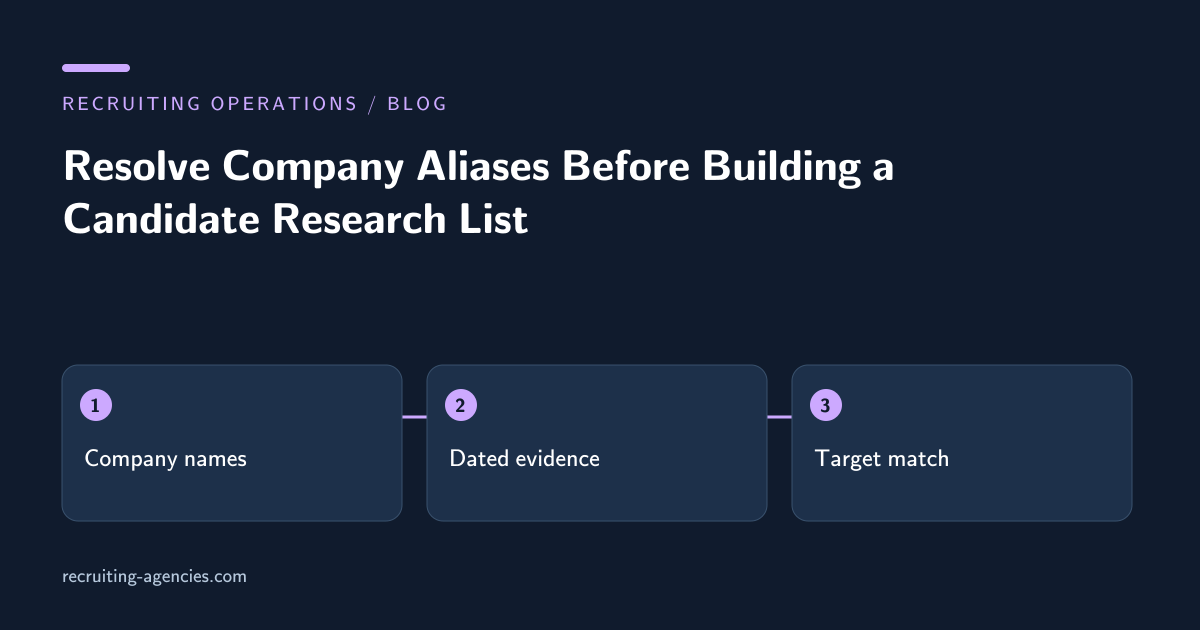
A recruiter asks for prospects from a target employer, and the assistant finds profiles naming three apparently different companies. One is the current brand, another is the company's former name, and the third is an unrelated business with a similar abbreviation. Combining them creates a misleading prospect list. Treating them as entirely separate can miss relevant experience.
Company alias resolution is a research preparation task. It helps a recruiting assistant search consistently and explain why a prospect was included. It does not establish that an individual worked for a particular legal entity, possessed a particular skill, or should be contacted. The recruiter chooses the target criteria and evaluates the resulting evidence.
Define why the employer matters
Ask what the recruiter means by experience at the target company. The relevant signal might be a product environment, a customer segment, a manufacturing process, or a geographic operation. A corporate relationship alone does not prove that every subsidiary shares that characteristic.
For example, a recruiter seeking experience with a specific enterprise product may care about the product division before and after a rebrand. A search for people who managed a local distribution center may require a particular site rather than the parent brand. These are different research boundaries and will produce different alias maps.
Write the target criterion in one sentence. Then list the names, divisions, locations, and time periods that the recruiter has approved. A researcher should not expand the search from one specialist subsidiary to an entire conglomerate merely to increase the number of results.
Build an alias map with dated evidence
Use first-party company pages, official announcements, and relevant public filings where available. Record the name as written, the relationship claimed, the source date, and the time period covered. A page that says “formerly known as” supports a different relationship from a page that says “part of” or “strategic partner.”
Distinguish at least four cases: a renamed organization, an acquired organization that continues to operate, a subsidiary under common ownership, and an unrelated organization with a similar name. These categories are research aids. If the evidence is unclear, use an unresolved category rather than forcing every name into the same corporate family.
A dated announcement can establish that an acquisition occurred, but it does not establish that all employees moved into the same function. Avoid converting company-level evidence into individual employment claims. In the prospect list, preserve the employer name shown by the person's source and link it to the alias map separately.
Keep search variants reproducible
Create a controlled list of approved name variants and abbreviations. Record punctuation and common spacing differences when they affect search results. Keep former names associated with their known period of use so the recruiter can distinguish historical experience from a current employer affiliation.
Run the variants separately when practical, then combine the resulting candidate references. This makes it possible to identify which alias produced a prospect. A single large search can obscure that origin and make later corrections difficult if one abbreviation turns out to refer to an unrelated employer.
Track the query date and source platform. Search results can change as profiles and indexes change. The record should describe what was observed, not claim that the list is a complete census of everyone who ever worked at the company. Avoid inventing a market-size conclusion from the number of results visible to one account.
Resolve ambiguous profiles conservatively
Suppose a public profile lists “Northline” with no location or website. The approved target is Northline Instruments, but another business called Northline Logistics uses the same short name. The assistant should not select the instruments company merely because it would make the candidate relevant.
Check other public evidence within the approved research scope, such as the person's description of the business or a linked employer page. If it remains ambiguous, mark the employer match as uncertain and explain the missing evidence. The recruiter can decide whether further confirmation is warranted.
Do not contact the person's current employer to verify the profile. A prospecting research task is not an employment verification assignment. Likewise, do not obtain restricted records or use personal accounts to circumvent access limits. Research should stay within the agency's approved sources and purpose.
Deduplicate people without erasing history
A prospect may appear under both the former and current company names. Use the approved person-matching rules to identify a likely duplicate, preserving both source references. The alias map explains why the employer names differ; it should not replace the evidence used to establish that the profiles concern the same individual.
Keep employment episodes distinct when they describe different roles or periods. A person who worked at a company before an acquisition and later returned to a subsidiary may have two relevant episodes. Collapsing them into one continuous tenure could exaggerate experience.
When the recruiter accepts a duplicate resolution, retain the source names in the research notes if policy permits. Future researchers may encounter the old brand again. A transparent mapping prevents the same ambiguity from being reopened every time the search is refreshed.
Show inclusion reasons in the handoff
The handoff should identify the candidate reference, source employer wording, normalized target group, relevant period, and confidence in the company match. Keep the inclusion reason specific: “profile names the approved product division under its former brand” is more useful than “good company background.”
Separate employer matching from skill assessment. A person may clearly match the target company while having no public evidence of the required role. Conversely, a relevant role description may be present while the employer identity remains uncertain. Give the recruiter those two observations independently.
The candidate research service scope describes support built around recruiter-approved criteria. This alias map fits that boundary: assistants organize evidence and exceptions, while recruiters decide how employer context affects the search.
Maintain the map as a research tool
Assign an owner to review new aliases discovered during the search. Record the change and affected queries rather than editing the list silently. If an alias is removed because it refers to an unrelated company, identify which prospects require reconsideration. Do not automatically delete those prospects; their other experience may still be relevant.
Review the map when the target list changes, a company announcement changes the evidence, or repeated ambiguous matches appear. There is no need to recreate it for every daily search if its scope and sources remain current. A short, controlled map is more useful than an enormous directory nobody can explain.
Does common ownership make two employers interchangeable?
No. Ownership is one relationship. Product, role, site, and time-period relevance still need their own evidence and recruiter approval.
What should an assistant do with a plausible but unconfirmed alias?
Keep it outside the confirmed search set and record the question. The owner can approve a limited exploratory search or request stronger evidence. To design a repeatable research handoff, discuss the workflow with a sanitized example of the employer ambiguity.