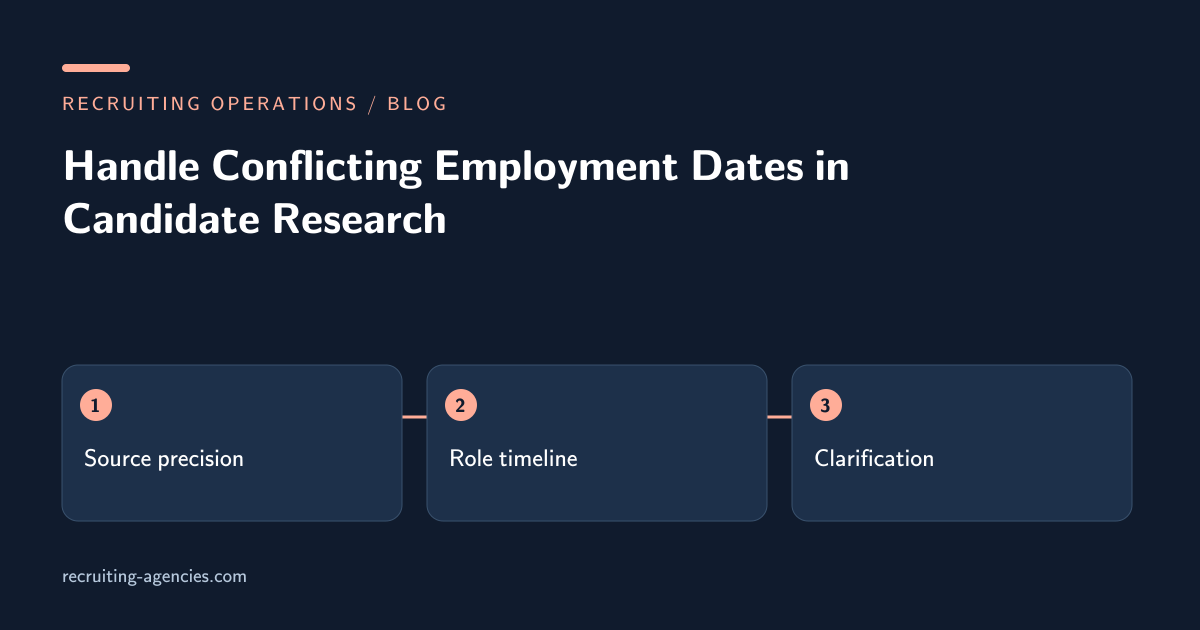
A résumé says a candidate joined an employer in 2021. A public profile says March 2022. An old company biography describes a different role in 2020. These statements may concern different dates, different positions, or an outdated page. Treating the newest-looking source as automatically correct can create a false employment history. Treating the discrepancy as dishonesty is an even larger unsupported step.
A recruiting assistant's task is to preserve what each source actually says and prepare a useful clarification for the recruiter. This is preliminary research, not a background investigation or an adjudication of the candidate's truthfulness. The method below keeps uncertainty visible without turning every small difference into a candidate-facing interrogation.
Record the date's precision
A year, a month, and an exact day contain different amounts of information. “2021 - 2023” does not establish that the person started on January 1 or left on December 31. Do not manufacture those dates merely because a spreadsheet requires a complete date value.
Use fields that preserve the original precision, or record a separate precision label where the approved system permits it. The recruiter should be able to distinguish an observed month from a placeholder used by software. If the destination cannot represent uncertainty, ask the system owner how to record it rather than inserting a plausible day.
The same rule applies to ongoing employment. “Present” describes the source's claim at an observation time. It is not independent confirmation that the person still works there today. Record when the source was checked and avoid automatically extending tenure in a way that implies fresh verification.
Separate employer tenure from role tenure
A person may have joined a company in 2021 and started their current role in 2022. Two sources can therefore show different start dates without conflicting. Read the surrounding text and identify whether each date concerns employment, a promotion, a contract assignment, or a particular project.
For an illustrative example, a résumé lists “Analyst, 2021 - 2022; Senior Analyst, 2022 - present.” A profile headline shows only the senior role beginning in 2022. The assistant should preserve both roles under the same employer if the evidence supports that structure. Replacing the employer start date with 2022 would erase the earlier period.
Agency placements add another distinction. A person might work at a client site while being employed by a staffing company. The recruiting owner should define which relationship the research needs to capture. Do not assume that the client name and employer name are interchangeable.
Create a discrepancy note with source boundaries
For each material difference, record the source reference, its publication or observation date, the exact employment episode, and the conflicting fields. Keep the note factual: one source states May and another states June. Avoid evaluative labels such as suspicious, inflated, or misleading unless the authorized reviewer has established a basis and approved that language.
A source may be old without displaying a date. Mark that limitation rather than inventing a freshness score. A recent page retrieval proves only that the page was reachable at that time; it does not prove the employer updated the biography recently.
Limit the note to information relevant to the approved role criteria. Do not expand the research into personal relationships, health, or unrelated life events in an attempt to explain a gap. The candidate can decide what additional context to provide through the appropriate recruiter conversation.
Decide which differences need clarification
The recruiter should set the materiality rule. A one-month difference caused by rounding may be irrelevant to an exploratory sourcing list, while an unresolved credential date may need a separate qualified review. The assistant can identify the discrepancy and its effect on the requested output without deciding its significance alone.
Avoid imposing a universal “gap tolerance” or rejecting prospects because a timeline is incomplete. Public profiles are often selective summaries. An absence of detail is not evidence that employment did not occur, and a gap is not evidence of a performance problem.
Prioritize questions that affect the specific research claim. If the handoff says a person has experience with a technology introduced during a particular period, the relevant question may be when they performed that work, not the exact day they joined the employer. Keep the clarification tied to the claim being made.
Prepare a neutral recruiter question
A useful question explains the context and asks for clarification without accusing the person. The recruiter might ask which dates should be used for the two roles shown in different documents. The assistant can draft that question for approval and provide the source references privately to the recruiter.
Do not contact a current employer, colleague, or reference as part of ordinary sourcing research. Verification activity requires its own authorization, procedures, and applicable legal review. The EEOC's background-check resources are relevant when an employer moves into background-check practices; they should not be treated as permission for an assistant to initiate checks.
If the candidate supplies a correction, record it as candidate-provided information with the date and source. Do not relabel it independently verified unless an authorized verification process actually supports that statement. The distinction protects the usefulness of the record at later stages.
Update without rewriting the evidence
Once the recruiter approves a corrected research summary, preserve the relevant source history according to the agency's policy. A later reviewer may need to understand why the summary differs from a publicly visible profile. A short note linking the correction is usually more useful than a long narrative of the entire exchange.
Recalculate derived tenure only when the input precision supports the calculation. A total expressed to the day is not credible when the underlying sources specify only years. Use an appropriately qualified description or omit the calculation when it adds false precision.
Check related records that used the disputed dates, such as a prospect shortlist or client submission draft. Updating the ATS alone does not correct a document already prepared from the old information. The assistant should identify affected outputs and route any external correction through the recruiter.
Keep unresolved differences visible
Sometimes no clarification is available before a research handoff. Label the relevant field unresolved and explain how that limits the summary. The recruiter can still evaluate other supported information rather than waiting for a perfect timeline.
An unresolved note should have a purpose and an owner. Do not keep recurring reminders active indefinitely when the recruiter has decided the detail is unnecessary for the current search. Close or defer the question explicitly, preserving the reason under the record-retention rules.
Should the assistant choose the résumé over a public profile?
Use the recruiter's evidence policy, and preserve any material disagreement. Candidate-provided material may be the preferred working source, but that preference does not erase a contradictory observation or establish independent verification.
What makes the final research useful?
The recruiter can tell what is known, how precise it is, what remains uncertain, and which claims should not be made. Review candidate research support or discuss an evidence handoff to define that standard for your searches.