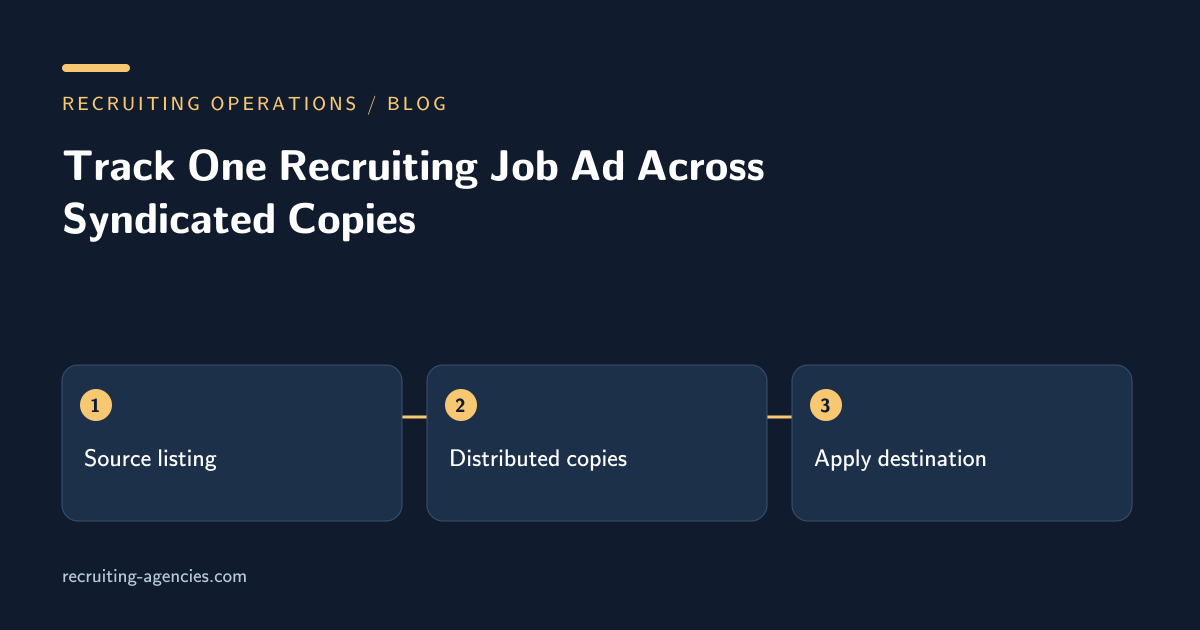
A recruiting agency approves one job advertisement, but candidates encounter several copies. The ATS hosts the original, a job board receives a feed, an aggregator discovers the board page, and a social post links to an older version. When the role changes, editing the original does not prove that every copy now agrees. The operational problem is distribution lineage: knowing where each version came from and where its application button leads.
A virtual assistant can maintain this map and collect correction evidence. The recruiter or employer still approves job content, compensation information, hiring status, and distribution channels. The assistant should not create extra advertisements to compensate for a copy that is difficult to update, because that can increase confusion and duplicate applications.
Give the vacancy one stable reference
Start with the employer-approved requisition identifier and the authoritative job page. Record the title, work location, employment arrangement, and approved content version. Do not use the title alone as the identifier; several vacancies may share the same title while having different locations or hiring managers.
The source record should say which organization controls the job page and who can authorize changes. An agency may administer a posting while the employer owns the underlying requisition. That distinction matters when a downstream platform asks the agency to confirm that a role remains open.
Keep a separate identifier for each platform's listing. A platform listing ID is not the same as the employer requisition ID. Mapping both allows the assistant to report exactly which copy is stale without confusing it with a different vacancy that happens to use similar wording.
Map the distribution path
For each discovered copy, record its URL, platform, apparent upstream source, first observation date, last checked date, and application destination. Mark the upstream source as unknown if the platform does not disclose it. A similar description is evidence of similarity, not proof of a particular feed relationship.
Distinguish direct postings from downstream copies. If the agency owns the account that posted a listing, it may have a supported edit path. If an aggregator copied another board, the correction might need to begin with the upstream platform. Trying to edit a downstream copy through an unrelated account can waste time or create another duplicate.
Do not assume that a search result disappearing means the underlying page has been removed. Open the saved direct URL and record its current behavior. Conversely, a cached search snippet can lag behind a corrected page. Keep page evidence and search-display evidence separate in the tracker.
Compare the fields that change candidate decisions
Prioritize the title, location or remote-work conditions, employment type, approved compensation disclosure, closing status, and application route. Formatting differences may be harmless; a changed location or unavailable application endpoint can materially mislead a candidate.
Use a concise difference record. For example: the authoritative page says two office days per week, while a downstream copy says fully remote. Capture the exact affected field and the source of the approved wording. The assistant should request a correction through the authorized channel rather than deciding that one version is more attractive and should prevail.
The Google Search documentation for job postings addresses consistency between structured information and visible job content, as well as handling expired postings. Those requirements apply to Google's job-search features; they are not a guarantee that every external board will update on the same schedule. Use each platform's current supported controls for its own copy.
Follow the application button
A duplicate advertisement is especially troublesome when it routes candidates into different application records. Open the application destination in an approved test context and check the requisition title and identifier before entering any data. Do not submit a fictitious application into production without explicit authorization for that test.
Record redirects that change the destination. A board URL may legitimately pass through tracking before reaching the employer's form, but a route that lands on a generic careers page may no longer identify the intended job. Escalate that mismatch even if the final page returns successfully.
When two copies create separate applications for the same role, the recruiter and ATS owner should decide how to reconcile them. The posting assistant can supply the source URLs and candidate journey evidence. It should not merge applicant records or erase source attribution merely to make the report look tidy.
Correct through the owner of each copy
Prepare a correction request with the listing ID, affected URL, approved replacement wording or closure instruction, and source evidence. Keep the requested change narrow. A platform support request should not include candidate information or internal recruiting discussions that are unnecessary to correct the advertisement.
Track the request state independently from the page state. “Support ticket submitted” means a request exists; it does not mean the public copy changed. Verify the direct page after the platform reports completion, and record any fields that remain inconsistent.
If a platform cannot be corrected immediately, tell the recruiter what candidates may still see. The recruiter can decide whether to adjust approved communications or temporarily stop a distribution path. The assistant should not promise a removal time that the platform has not confirmed.
Close a role across the map
When the employer closes a requisition, apply the approved closure sequence to the authoritative source and controlled copies. For downstream copies, record the removal or expiration request and recheck according to the team's agreed schedule. Do not simply change the publication date to make an old advertisement look current.
A role can be filled, cancelled, paused, or replaced by a genuinely different requisition. Those states may require different public messages. The owner should choose the wording and whether a new listing is appropriate. A paused role should not remain actively soliciting applications unless the employer has approved a truthful explanation.
Preserve enough history to explain late-arriving applications. A candidate may have started from a stale external copy even after the source closed. The distribution map lets the team identify that route without blaming the candidate or assuming the ATS malfunctioned.
Review duplicates as an operational pattern
Count controlled listings, known downstream copies, unresolved inconsistencies, and application-route defects separately. A high number of copies is not automatically a success measure; it may represent redundant distribution or stale content. Look for recurring sources of incorrect copies and discuss them with the channel owner.
Should every identical copy be removed?
Not necessarily. Authorized syndication can be intentional. The question is whether the copy is accurate, controlled through a known path, and connected to the intended vacancy.
What proves a correction is complete?
A direct check of the affected public page and application destination, with the result recorded against the specific listing. For assistance maintaining this distribution map, review job posting administration or discuss the posting workflow.