A recruiting manager sees 24 candidates in interview on Friday and asks why the weekly report lists 31 interview-stage entries. Both numbers can be correct. One describes candidates present at a particular moment; the other describes movements during an interval. Confusing these measures creates unnecessary cleanup work and sometimes leads teams to edit accurate records until two unrelated numbers agree.
A virtual assistant preparing recruiting reports needs an explicit distinction between a snapshot and activity. This article explains how to reconcile the two, including applications that reopen, move between requisitions, or enter a stage more than once. It is an operating method, not a benchmark for how large a healthy pipeline should be.
Choose the thing being counted
Decide whether the unit is a person, an application, a requisition, or a stage event. One person can apply for two roles. One application can have several interviews. If the opening count uses people and the closing count uses applications, no amount of arithmetic will repair the mismatch.
For a stage reconciliation, an application is often a useful unit because it belongs to a particular requisition and has a stage history. The reporting owner must still decide whether a second entry into the same stage counts as another event. Write that choice into the report definition before extracting data.
This distinction has an official statistical analogue. The Bureau of Labor Statistics' JOLTS definitions distinguish job openings measured at a point in time from hires and separations measured over a period. An agency's ATS measures are not JOLTS statistics, but the same need to define the observation window applies.
Freeze both cutoffs
A weekly interval needs a start instant, an end instant, and a reporting time zone. “Last week” is not sufficient when recruiters work in different locations. Decide whether an event exactly at the end boundary belongs to this interval or the next, and use the same rule in every extraction.
Save a restricted reference to the opening snapshot before the week's records change. If the ATS only exposes current state, reconstructing Monday's pipeline on Friday may be impossible without an event history. Do not infer the opening stage from a current record and present that estimate as an observed snapshot.
Separate event occurrence time from entry time. A recruiter may record Thursday's interview on Monday. Depending on the report's purpose, the event belongs to the interview week while the correction appears in the later reporting revision. State the policy so late entries do not quietly rewrite previously issued totals.
Use a movement equation
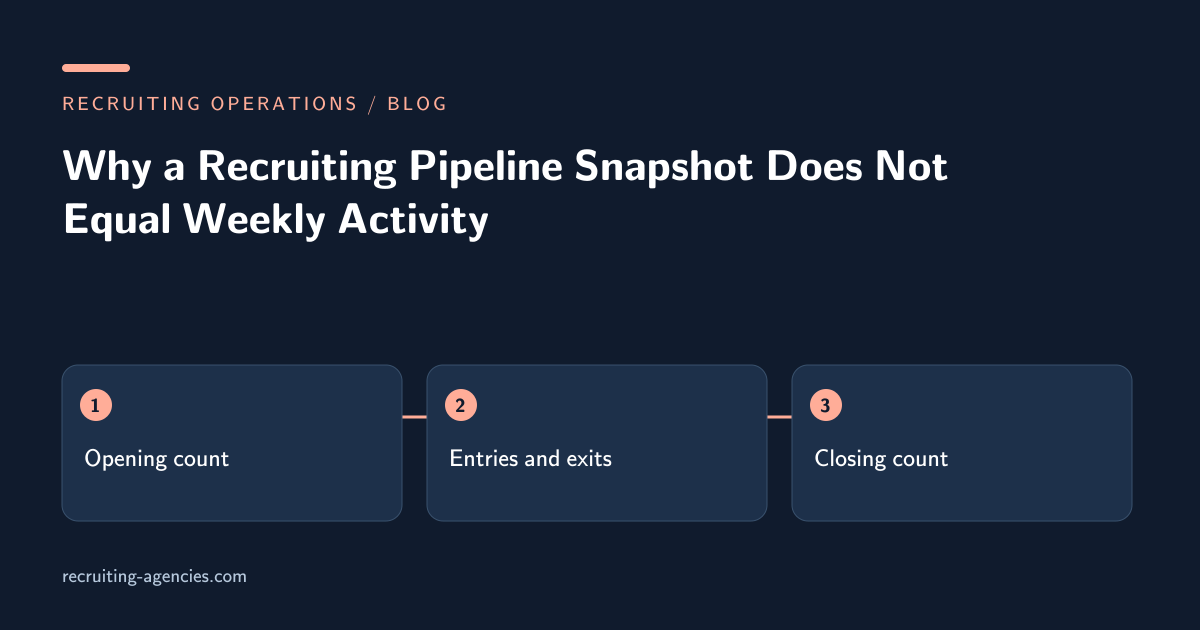
For a chosen stage, start with opening applications, add entries, subtract exits, and reconcile explicit adjustments to the closing applications. Adjustments include identified corrections and scope changes; they are not a miscellaneous bucket for unexplained differences. Every adjustment should have a traceable record and a reason.
Consider an illustrative week with 20 applications in interview at the opening cutoff. Twelve enter the stage and nine leave it. One application is removed because a duplicate was confirmed, and one is transferred into the reporting scope from another team. The expected closing count is 23. The adjustment pair nets to zero, but showing both events explains why the underlying inventory changed.
If the closing snapshot contains 24, do not immediately subtract one from the activity report. Identify the unmatched application. It may have been reactivated without an event, entered using a different time field, or included under a changed requisition filter. The difference is a diagnostic signal, not an invitation to force agreement.
Handle re-entry explicitly
An application can leave interview for an offer discussion and return to interview for an additional assessment. In an event-based report, that creates an exit and a new entry. In a distinct-application report, it may still count as one application interviewed during the period. Neither definition should be hidden behind the label “interviews.”
Keep a stage-event sequence for exceptions. Record the application reference, previous stage, new stage, event time, and correction status. The assistant can assemble this sequence without deciding whether the additional interview was necessary. That business interpretation remains with the recruiter.
Avoid removing a re-entry merely because it looks like a duplicate. Two identical stage names with different timestamps can represent real operational work. Conversely, two identical events from a synchronization retry may be a technical duplicate. Use event identifiers and system evidence to distinguish them before changing counts.
Separate transfers from recruiting progress
Moving an application from one recruiter or team to another can change each team's snapshot without advancing the candidate. A team-level report should show an inbound or outbound transfer if ownership defines its scope. A company-wide report may show no net change at all.
A requisition transfer can be more complicated. If the ATS creates a new application, the reporting owner must decide how to preserve the relationship to the original. Counting the new application as a newly sourced person would overstate sourcing activity. Keep the application creation event separate from the person's first entry into the agency's records.
When a requisition closes, identify whether applications exit the pipeline, remain open for follow-up, or move into another defined category. Do not assume a closed role means every associated candidate has received a final communication. Reporting state and communication state can differ legitimately and should be reconciled through their own owners.
Make discrepancies reviewable
Prepare a compact exception table rather than sending the manager a complete export. Include the application reference, expected movement, observed state, likely source of the difference, and the system owner needed to resolve it. Label a suspected cause as a hypothesis until the relevant evidence confirms it.
Use a short revision note when a correction changes an issued report. Explain the affected period, measure, and count. Keep the original version accessible under the organization's retention rules. A transparent correction is more useful than silently replacing last week's file and leaving managers with conflicting copies.
For routine production, the assistant should run the same reconciliation before formatting charts. Chart polish cannot compensate for a denominator that changes mid-report. Once the counts reconcile, add the owner-approved commentary and keep any unresolved exception visible beside the affected measure.
Should activity always exceed the closing pipeline?
No. A large opening pipeline with little movement can produce the reverse. The measures answer different questions, so there is no universal ordering between them.
Can the report show both views?
Yes. Label a snapshot with its exact cutoff and label activity with its interval and event definition. A manager can then distinguish current workload from movement without assuming that either is a performance judgment. Review recruiting reporting support to define the extracts and reconciliation evidence, or discuss your reporting workflow with a sanitized example.