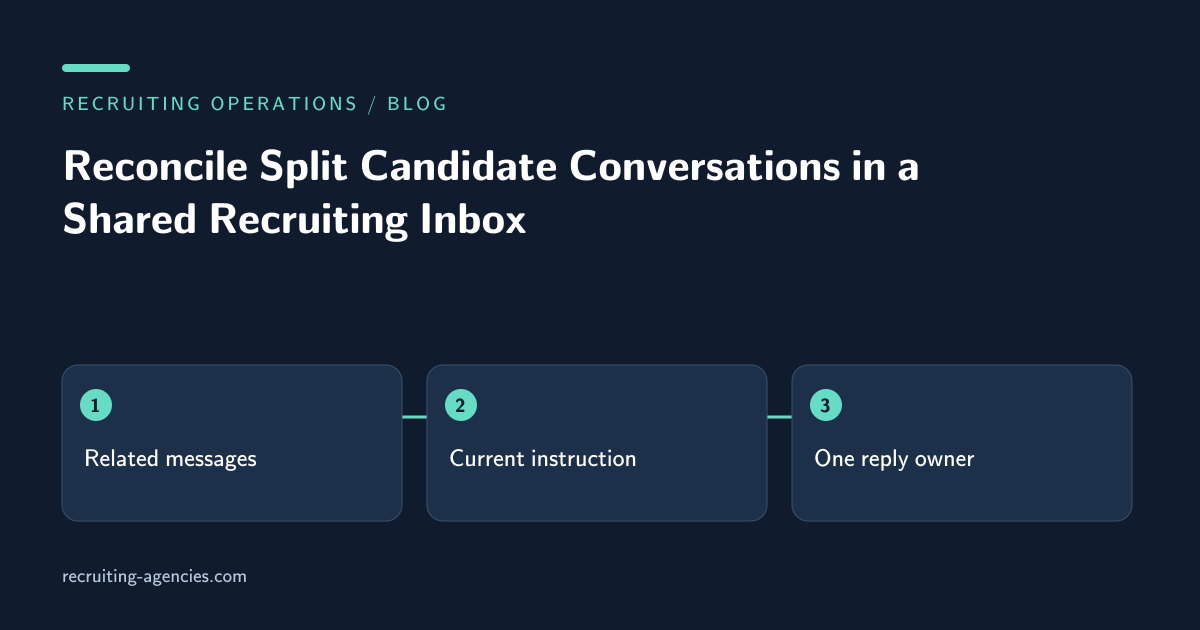
A candidate replies to a recruiter, forwards the same answer to the scheduling inbox, and later sends a correction from another address. One assistant books Tuesday while another tells the recruiter that Wednesday is confirmed. Every person has read a real message, but nobody has reconstructed the whole conversation. Thread reconciliation prevents that kind of conflict without requiring every employee to read every mailbox.
The task is to connect related messages, identify the latest confirmed instruction, and assign one reply owner. It is not permission to combine uncertain identities, expose one client's search to another, or decide a candidate's preferences from hints. A recruiting assistant should work inside the approved communication scope and escalate ambiguity before acting on it.
Identify the conversation by purpose
Start with the candidate reference, requisition, and immediate question. An email subject is helpful but not a reliable identifier. Candidates reuse subjects, recruiters forward chains, and automatic systems can create fresh threads for the same appointment.
Distinguish conversations about different roles. A candidate can be available Tuesday for one client's interview and unavailable for another event that requires travel. Combining those answers into a single global availability field would discard the context that makes each answer meaningful.
Record the decision being coordinated: selecting an interview slot, confirming receipt of a document, or answering a role question. This keeps the reconciliation bounded. The assistant does not need to assemble the candidate's entire correspondence history to answer one scheduling question.
Gather the authorized message references
Use only mailboxes and records the assistant is permitted to access. Link the relevant messages in the approved system where possible rather than copying long chains into a new document. Forwarded messages may contain unrelated client or candidate information below the visible reply.
Capture sender, recipient, sent time, received time where relevant, and a short description of the action requested. A forwarded message's forwarding time is not the time the candidate originally made the statement. Keep those timestamps separate so a recent forward cannot accidentally override a newer candidate correction.
When messages arrive through an ATS integration, check whether the visible timestamp represents the original send or the synchronization event. The assistant can note the ambiguity and ask the system owner how the integration records it. Do not infer chronology from the order in which messages happen to appear on screen.
Verify identity before joining addresses
A candidate may use a personal address for correspondence and a different address for an application. Join those addresses only under the agency's approved identity-confirmation procedure. Similar names or signatures are not sufficient when the action could disclose confidential role information.
If the person explicitly confirms a new address through an established channel, record that evidence and the allowed communication purpose. Do not delete the old address merely because a new one appeared. The recruiter or data owner should decide how contact preferences and historical messages are maintained.
If identity remains uncertain, keep the message separate and send it to the designated owner for review. It is better to delay one response than to disclose another candidate's interview details. The FTC's information-protection guidance supports restricting access and limiting unnecessary personal information; this workflow applies those principles to message handling.
Distinguish a new instruction from quoted history
Email chains often repeat earlier answers below the latest reply. Read the newly authored text before extracting a preference. A candidate may write “Wednesday no longer works” above an old message saying “Wednesday is best.” Automated snippets and hurried manual review can select the obsolete sentence.
Record corrections explicitly. For an illustrative scheduling case, the first answer offers Tuesday or Wednesday, the second selects Wednesday, and the third withdraws Wednesday because of a new conflict. The current state is not Tuesday confirmed. It is that Wednesday is unavailable and a new selection is needed.
Silence also is not a correction. If the recruiter proposes Thursday after the candidate withdraws Wednesday, the assistant should record the proposal as awaiting confirmation. Do not convert a sent proposal into an accepted appointment simply because it is the newest message in the chain.
Assign one response owner
Before drafting a reply, mark who owns the current response in the shared system. The mechanism might be an assignment field, approved label, or queue status. It should be visible to everyone who could otherwise answer the same conversation.
A response owner is different from the person authorized to make the underlying decision. The assistant may own sending a approved scheduling clarification while the recruiter owns any change to interview format. Keep that distinction visible so a shared-inbox assignment does not silently grant broader authority.
If two replies have already been sent, compare them and identify the actual conflict. Ask the recruiter to approve a single correction where necessary. Do not send a third message that merely repeats one of the earlier versions without acknowledging which instruction now applies.
Draft from the reconciled state
Use a short internal summary: confirmed facts, unresolved question, proposed reply, and any required approval. For example, the candidate has withdrawn Wednesday, Tuesday has not been confirmed, and the interviewer can now offer Thursday. That summary gives the approver enough context without requiring them to read a lengthy forwarded chain.
The candidate-facing message should focus on the next useful action. It can clarify the available options and ask for a selection without describing the agency's internal mailbox confusion. If an agency error caused a contradictory instruction, acknowledge the correction plainly and specify which earlier instruction is superseded.
Check the recipients before sending. Reply-all can expose client contacts or include an address that should no longer receive role details. Follow the approved recipient list for the particular conversation, not whichever list happens to remain in the longest email chain.
Close the loop in the ATS
Once the approved reply is sent, link it to the candidate and requisition record. Mark what remains outstanding and when the owner should review it. Closing the inbox task should not falsely indicate that the underlying interview or decision is complete.
If the conversation produced a confirmed booking, reconcile the calendar event separately. The communication record may be correct while an old invitation still exists. Conversely, a calendar event can exist while the candidate has not accepted the proposed time. Each system needs evidence appropriate to its role.
Should assistants merge every similar thread?
No. Connect messages only when identity and purpose are sufficiently established. Preserve separate threads for different requisitions or unresolved identities, with a note explaining the relationship under review.
What is the most useful completion check?
Another authorized teammate should be able to identify the current confirmed instruction, the last sent reply, and the next owner without reconstructing the entire mailbox. Review candidate communication support or discuss a shared-inbox workflow to set that standard for your agency.