Key takeaways
- Define access by task and duration, not by job title alone.
- Separate candidate, employee, and client data permissions.
- Test revocation and export before signing a long-term operating model.
An RPO or embedded recruiting agency can improve continuity by working inside a client's applicant tracking system, scheduling tools, email, reporting workspace, or background-screening platform. The same access can create an outsized failure if an account is shared, a permission is too broad, or the relationship ends without a clean handoff.
This guide applies the practical principles of least privilege, purpose limitation, and accountable operations to recruiting partnerships. NIST's Cybersecurity Framework and the FTC's business guidance provide public reference points. They do not replace the client's security program, privacy obligations, or contract review.
Build an access inventory
List every system, data class, action, owner, and expiry date before access is granted. Do not write “ATS access” as the permission. Separate viewing a candidate profile from exporting it, editing disposition reasons, sending messages, changing a job, or deleting a record.
| Domain | Examples | Questions |
|---|---|---|
| Candidate | Résumé, notes, consent, screening status | What may be viewed, edited, exported? |
| Client | Hiring plans, compensation, interview feedback | Who may see confidential searches? |
| Employee | Payroll or onboarding identifiers | Is access needed at all? |
| Operations | Calendar, email, dashboards | Which actions require approval? |
| Security | Logs, API keys, integrations | Who can rotate or revoke access? |
The agency should receive the minimum access needed for its assigned work. If a recruiter only schedules interviews, do not grant compensation-edit or candidate-export permission. If the team needs reporting, provide a scoped view or report rather than administrator rights.
Map access to workflow stages
Access should follow the recruiting process. A sourcing partner may need a requisition summary and a way to record outreach; an interview coordinator may need calendars and candidate contact details; an RPO lead may need aggregate funnel data but not every medical or background-screening detail. Stage-based permissions are easier to review than a single permanent role.
Set start and end dates for contractors and temporary teams. Require individual accounts, multi-factor authentication where supported, and named owners for service accounts. Prohibit shared passwords. A role change should trigger access review rather than silently inheriting the previous permissions.
Make auditability part of the service
Ask what each system logs: sign-in, view, download, edit, export, deletion, message, and permission change. Determine who reviews alerts, how quickly an incident is escalated, and how long logs are retained. A vendor's statement that it is “secure” is not an operational control unless the client can inspect relevant evidence or receive a report.
Use a small test candidate and requisition in a non-production environment where possible. Confirm that a recruiter can complete the approved workflow and cannot access a restricted field. Test whether an export contains more data than the user saw on screen. Record results and exceptions before granting production access.
Separate data responsibilities
The agreement should identify the client's role, the agency's role, subprocessors, permitted purposes, retention, deletion, incident notice, and cooperation with candidate requests. Specify whether the agency may copy data into its own CRM, use it for another client, or use it to train or evaluate a system. Do not infer permission from technical ability.
Background-screening information deserves extra separation. The FTC and EEOC explain that consumer reports used for employment decisions carry specific notice, authorization, and adverse-action requirements. Recruiters should see the workflow status they need, not necessarily the full report. Define who may receive sensitive results and who communicates decisions.
Plan the exit before the start
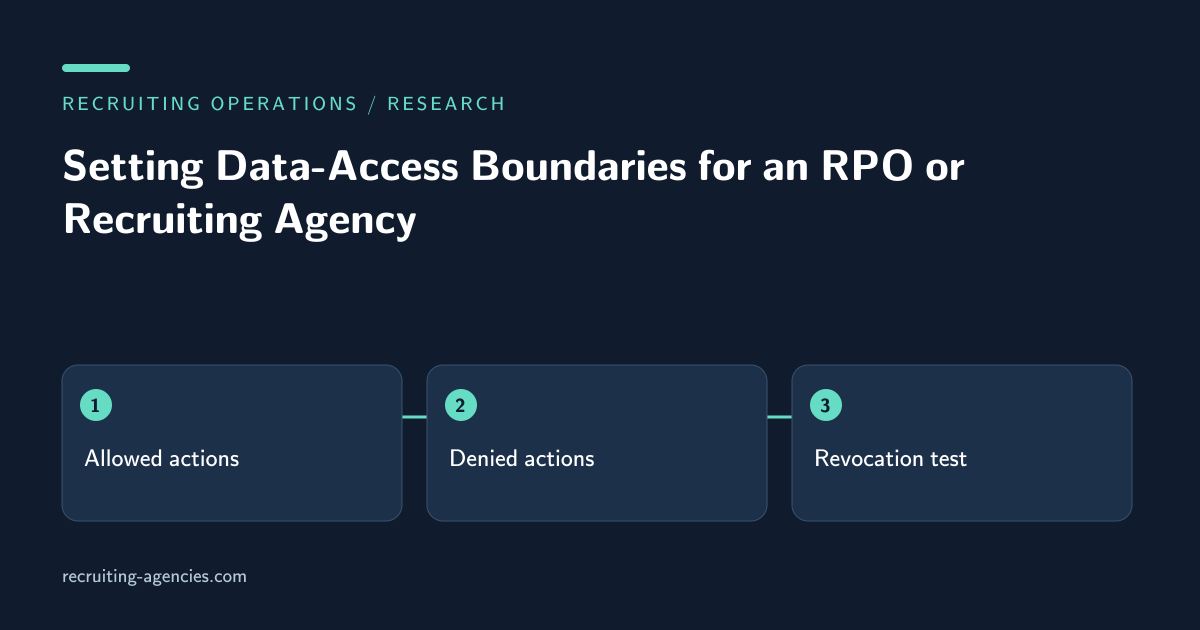
An access plan is incomplete without a revocation and return test. Ask the agency to demonstrate: disabling a user, rotating a service credential, removing an integration, exporting agreed records, returning client-owned work product, deleting unauthorized copies, and identifying the remaining logs. Put a named owner and deadline on each step.
Run the test after a pilot and before renewal. A long relationship can accumulate spreadsheets, inbox rules, browser tokens, and informal copies outside the original system inventory. The exit review should look for those surfaces without asking the agency to expose unrelated client data.
Compare proposals fairly
Give each agency the same five scenarios: new recruiter onboarding, recruiter transfer, confidential executive search, suspected data export, and contract termination. Ask for the exact permission, approval, audit, and response path. Score the answer for least privilege, named ownership, evidence, speed of revocation, and candidate impact.
A mature proposal should explain which work it can perform without administrator rights and where the client must retain approval. Treat refusal to document data boundaries as a material diligence finding.
Limitations and decision rule
Proceed when access is individual, task-scoped, time-bounded, logged, reviewed, and revocable; sensitive data is separated; and the exit test succeeds. Pause when the agency requests shared credentials, cannot name subprocessors, exports candidate data by default, or cannot revoke access quickly.
NIST frameworks are guidance, not a recruiting contract. Security, privacy, employment, and records requirements vary by system and jurisdiction. Have the client's security and legal owners review the final design, especially where the agency can access health, identity, financial, or background-screening information.
Test both allowed and prohibited actions
An access demonstration should include a negative test. If an interview coordinator is allowed to view candidate contact details but not export the entire database, verify both conditions with a designated test account. A demonstration that shows only successful scheduling proves little about the export boundary. Use synthetic records and an approved environment; do not attempt unauthorized access to real candidate information.
Write an expected-permission table before the test. Each row names an action, the allowed scope, the expected denial outside that scope, and the owner who approves the configuration. Include a confidential requisition outside the coordinator's assigned team. The system should behave according to the approved rule, and any broader visibility should become an explicit finding rather than a convenient shortcut.
Revocation requires more than disabling an interactive login. Ask the system owner which active sessions, delegated mailbox permissions, scheduled exports, and integration credentials remain relevant. Test those surfaces through supported administrative controls. A person who can no longer sign in may still receive a scheduled report containing candidate data if that distribution was not included in the exit process.
Use an illustrative exit scenario in which a contractor changes clients on Friday. Identify the exact time their access should end, who performs the change, and what evidence confirms it. The receiving team should not inherit the former client's permissions. Preserve the result in the access review record without exposing unrelated client data to the departing contractor or the new client.
Classify an unresolved permission as a specific exception with a limited scope and an accountable owner. A generic statement that the agency follows least privilege does not explain why a scheduler can export records. The contract discussion should address that observed gap and whether the service can operate safely with narrower permissions.
For a practical administrative scope, review ATS pipeline management support and discuss the access boundary. Configuration decisions and security acceptance remain with the client's system and security owners.
Distinguish a documented exception from permission drift
During the pilot, compare the approved matrix with the system's actual role configuration. An administrator may discover that a bundled role grants both scheduling and export privileges. Record that product limitation explicitly. The client can then choose a narrower supported role, an approved compensating control, or a different operating arrangement. Do not describe the access as task-scoped simply because the contract tells the user not to exercise the extra permission.
Recheck the matrix when a platform changes its role definitions. A permission name can stay the same while the actions behind it expand. The review owner should compare capabilities and evidence, not just confirm that the same label remains selected.
Trace the scheduled report after a recruiter leaves
A fictional RPO coordinator receives a daily interview report through an approved shared mailbox. When that coordinator leaves the assignment, disabling the ATS account may not change the mailbox membership or the report's delivery destination. Treat the report as a separate access path in the exit exercise. Identify the report owner, recipient group, delivery schedule, included fields, and location of any retained copies before deciding which administrative changes are necessary.
Have the authorized system owner demonstrate the expected result using synthetic records. The successor should receive only the approved scheduling information, and the departing user's access to the shared destination should end according to the agreed cutoff. The coordinator documenting the exercise records what was observed; they should not try alternate credentials or unsupported workarounds to test the boundary. An inconclusive test remains inconclusive until the owner supplies appropriate evidence.
Distinguish stopping future delivery from handling existing copies. Cancelling a report does not explain what happens to an earlier attachment already retained in a mailbox. The client and agency need a documented disposition for those copies under their agreed retention and return requirements. Close the exit record with separate results for account access, report delivery, destination membership, and retained material. That separation makes an incomplete exit visible even when the primary login has been successfully disabled.
Sources
- NIST, Cybersecurity Framework 2.0 - checked October 2, 2026.
- NIST, Privacy Framework - checked October 2, 2026.
- Federal Trade Commission, Protecting Personal Information: A Guide for Business - checked October 2, 2026.
- Federal Trade Commission, Background Checks: What Employers Need to Know - checked October 2, 2026.
Frequently Asked Questions
Should an RPO have administrator access to the ATS?
Only when a documented task requires it, the permission is approved, and compensating controls exist. Most workflow tasks should be scoped more narrowly.
Who owns candidate data in an RPO?
The contract should say who controls each purpose, who may process it, and what happens at exit. Technical custody does not answer the governance question.
What is the fastest useful access test?
Use a test account and a realistic requisition to verify view, edit, export, log, and revoke behavior before production access.
Apply the research to your agency search
Tell us what you need to hire, and we will help you compare recruiting partners built for the assignment.
Get a researched shortlist